
How to dissolve a partnership in Ontario depends first on your partnership agreement, which governs. Where there is no agreement, or the agreement is silent, the Partnerships Act, R.S.O. 1990, c. P.5 fills the gap. A partnership entered into for an undefined time can be dissolved by one partner giving notice to the others. It also ends when a fixed term expires, a single undertaking is complete, a partner dies or becomes insolvent, or the business becomes unlawful, and a court can order dissolution on specified grounds. Dissolution then starts a winding-up, with a statutory order of payment.
Below is that sequence, section by section, so you can see the whole process before you speak to a civil litigation lawyer in Toronto. It addresses general partnerships; the Act has separate provisions for limited liability partnerships (s. 44.1 onward), and their rules may differ.
Start with the partnership agreement, because the Act only fills gaps
The dissolution rules in the Partnerships Act are expressly “subject to any agreement between the partners” (s. 32). The same qualifier appears in s. 33 (death and insolvency) and s. 44 (distribution). If your agreement deals with a point, it usually controls.
When you read your agreement, look for:
- an exit or buy-sell mechanism
- a valuation method for a departing partner’s share
- notice periods and how notice must be given
- restrictive covenants, such as non-competition or non-solicitation terms
- what happens to the business name and the client list
A well-drafted agreement makes much of the rest of this article unnecessary. Where it is silent, the statute supplies the answers.
How to dissolve a partnership in Ontario: the legal routes
By expiry of a fixed term, or completion of the undertaking
Under s. 32(a) and (b), a partnership for a fixed term is dissolved when the term expires, and one for a single adventure or undertaking when that undertaking ends.
By one partner giving notice
Under s. 32(c), where a partnership was entered into for an undefined time, any partner can dissolve it by giving notice to the other partners of their intention to do so. The partnership is dissolved as from the date named in the notice. If no date is named, it is dissolved from the date the notice is communicated.
That date matters because it fixes when the winding-up obligations begin. Name a date, and keep proof of when each partner received the notice.
By death or insolvency of a partner
Under s. 33(1), subject to any agreement, the death or insolvency of a partner dissolves the partnership as regards all the partners. This surprises people, particularly in two-person partnerships. Separately, s. 33(2) allows the other partners, at their option, to dissolve the partnership if a partner’s share is charged for that partner’s separate debt.
By the business becoming unlawful
Under s. 34, a partnership is dissolved in every case by any event that makes it unlawful for the business to be carried on, or to be carried on in partnership.
By court order
Under s. 35(1), a partner can apply to the court, and the court may order dissolution where:
- a partner has been found incapable as defined in the Substitute Decisions Act, 1992
- a partner, other than the one applying, has become permanently incapable of performing their part
- a partner has been guilty of conduct calculated to prejudicially affect the carrying on of the business, having regard to the nature of the business
- a partner wilfully or persistently breaches the partnership agreement, or behaves in a way that makes it not reasonably practicable for the others to carry on in partnership with them
- the business can only be carried on at a loss
- circumstances have arisen that make it just and equitable for the partnership to be dissolved
This is usually the route where a fixed term or agreement rules out dissolution by notice, or a partner will not cooperate.
Winding up: what still has to happen after dissolution
Dissolution does not end the partners’ obligations. Under s. 38, after dissolution the authority of each partner to bind the firm, and the other rights and obligations of the partners, continue so far as necessary to wind up the partnership’s affairs and to complete transactions begun but unfinished at the time of dissolution, but not otherwise.
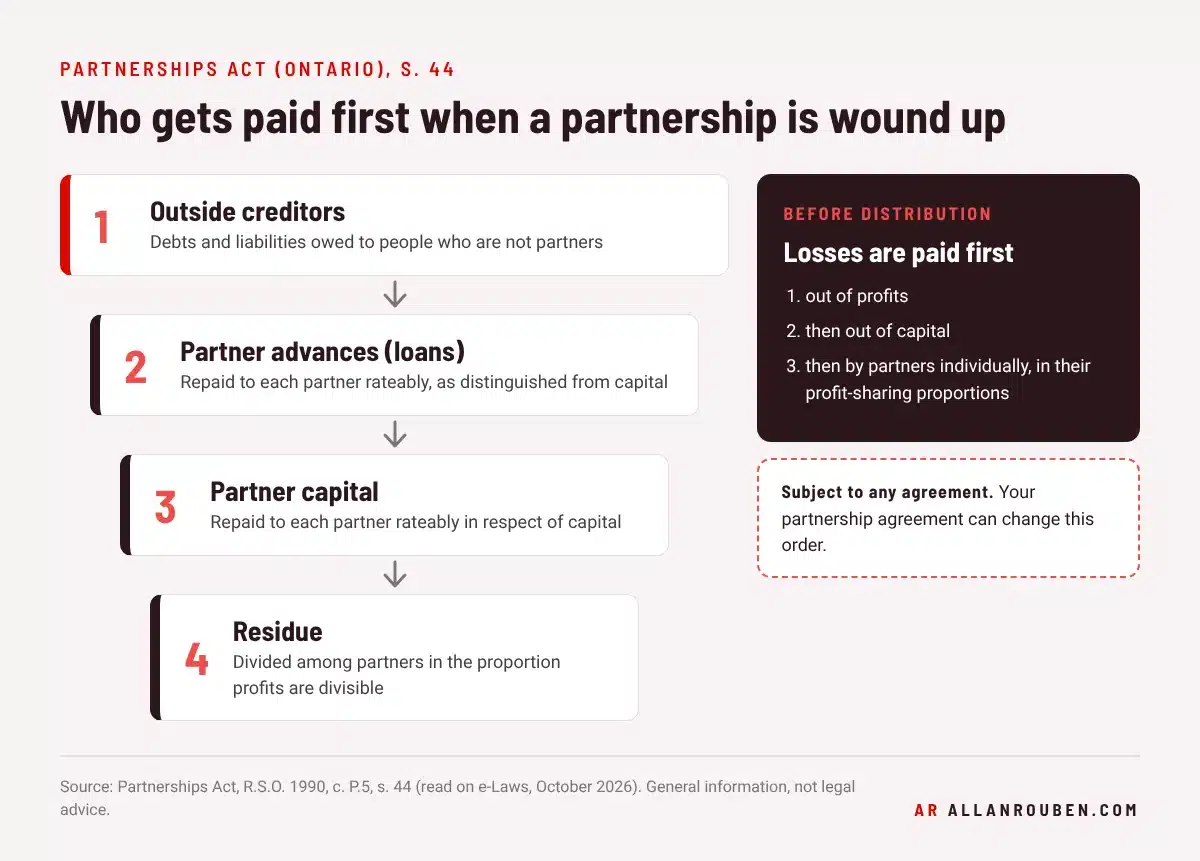
Section 44 then sets the order of settlement, subject to any agreement. Losses, including losses and deficiencies of capital, are paid first out of profits, next out of capital, and lastly by the partners individually in the proportion in which they were entitled to share profits. The firm’s assets, including any sums partners contributed to make up losses or deficiencies of capital, are then applied in this order:
- paying the firm’s debts and liabilities to people who are not partners
- paying each partner rateably what is due to them for advances, as distinguished from capital
- paying each partner rateably what is due to them in respect of capital
- dividing any remaining residue among the partners in the proportion in which profits are divisible
In practice: outside creditors are paid before partners, and a partner’s loan to the firm ranks ahead of that partner’s capital.
Telling the world, and why skipping it can cost you
Under s. 36(1), a person who deals with a firm after a change in its constitution is entitled to treat all apparent members of the old firm as still being members until they have notice of the change. If customers and suppliers were not told, a departing partner may still appear to them to bind the firm.
Section 36(2) provides the formal mechanism. The Ontario Gazette is the Ontario government’s official publication for public and legal notices, and under the Act, “An advertisement in The Ontario Gazette shall be notice as to persons who had not dealings with the firm before the dissolution or change so advertised.”
Under s. 36(3), the estate of a partner who dies or becomes insolvent, and a retiring partner not known to be a partner by the person dealing with the firm, are not liable for partnership debts contracted after the date of death, insolvency or retirement. Under s. 37, any partner may publicly give notice of the dissolution and require the others to concur in the necessary acts, which helps if one partner is obstructive.
In practice: give direct written notice to everyone the firm has dealt with (customers, suppliers, the bank, the landlord, the insurer) and a Gazette notice for everyone else.
Registration and administrative clean-up
Dissolving a business partnership also means administrative clean-up, typically:
- the business name registration
- the CRA business number and program accounts, including HST and payroll
- bank accounts and any personal guarantees
- insurance policies and leases
- the partnership’s final tax filings
Paperwork does not end liabilities. Cancelling a registration does not discharge a debt or release a guarantee. If your business is incorporated, it is not a partnership, and it is dissolved through the corporate process under the Business Corporations Act instead.
What happens when there is no partnership agreement
Dissolving a partnership without an agreement means the Act’s default rules apply, and they are often not what partners assumed. Under s. 24, subject to any agreement express or implied:
- all partners share equally in capital and profits, and contribute equally to losses
- every partner may take part in managing the business
- no one can become a partner without the consent of all existing partners
- ordinary matters are decided by a majority, but the nature of the business cannot be changed without the consent of all partners
- the books are kept at the place of business, and every partner may access, inspect and copy them
The Act also imposes duties that matter on the way out: true accounts and full information to the other partners (s. 28), accounting for any benefit taken without consent from partnership transactions, property, name or connections (s. 29), and paying over profits from an unauthorized competing business (s. 30). These overlap with the duties partners owe one another.
When dissolution turns into a dispute
The usual flashpoints are valuation, who keeps the name and the clients, unequal capital accounts, and personal guarantees that outlive the partnership. Under s. 42(1), if the continuing partners carry on with the firm’s assets without a final settlement, the outgoing partner or their estate may, absent a contrary agreement, elect either a share of later profits attributable to their share or interest at 5% per year on it. Under s. 43, subject to any agreement, the amount due to an outgoing or deceased partner for their share is a debt accruing at the date of dissolution or death.
If you are already in conflict, see our post on partnership disputes in Toronto. A dispute may also involve a breach of contract claim under the partnership agreement, and where a ruling is challenged, commercial appeals. If your business is a corporation, see our article on shareholder disagreements.
How long it takes, and what it costs
An agreed dissolution is mainly administration. A contested application under s. 35 is litigation, with a litigation timeline and costs exposure. The key variables are whether there is a written agreement, whether value is agreed, whether the business continues, and whether creditors are pressing.
Frequently asked questions
How do you dissolve a business partnership in Ontario?
Follow your partnership agreement first. If it is absent or silent, the Partnerships Act applies: a partnership for an undefined time ends on one partner’s notice, and partnerships also end on expiry of a term, death, insolvency, illegality or court order. The partners then wind up, settle accounts in the statutory order, and give notice.
Can one partner dissolve a partnership without the others agreeing?
Yes, if the partnership was entered into for an undefined time and no agreement says otherwise. Section 32(c) of the Partnerships Act lets a partner dissolve it by giving notice to the others. If there is a fixed term, or an agreement restricting dissolution, notice alone may not work, and the route may be a court application under s. 35, which includes a “just and equitable” ground.
What happens to partnership debts after dissolution?
They remain payable. Partners keep authority to wind up affairs and finish unfinished transactions (s. 38). Outside creditors are paid from the firm’s assets before partners recover advances or capital (s. 44). Until people who dealt with the firm have notice of the change, they may treat former partners as still being members (s. 36(1)), so give notice promptly.
Do I need a court order to dissolve a partnership?
Usually not. Most partnerships end by agreement, notice, expiry of a term or another event under the Act. You need a court order when you cannot otherwise end it, on grounds such as a partner’s incapacity, conduct making it impracticable to continue, persistent breach, a business that can only run at a loss, or circumstances making dissolution just and equitable.
What is the procedure for dissolving a partnership?
In order: check the partnership agreement; establish the dissolution route and the date it takes effect; wind up the business and complete unfinished transactions; settle accounts, paying outside creditors first, then partner advances, then capital, then any residue; give direct notice to people the firm dealt with and a notice in The Ontario Gazette; and close registrations, tax accounts, bank accounts and leases.
This article is general information about Ontario law as of October 2026, not legal advice. Your options depend on your facts and documents.
If your partners cannot agree on value, the name, the clients or the accounts, it helps to understand your position early. Allan Rouben is a Toronto lawyer with over 35 years of experience. Book a free consultation to discuss your options.