
Can I sue my financial advisor in Ontario? Yes, but losing money is not enough on its own. You have to show that the advisor fell below the standard of care expected of a reasonably careful advisor in their position, and that this failure, rather than the market, caused your loss. A claim can also be framed in contract, breach of fiduciary duty or misrepresentation, depending on the facts. In most cases you have two years from the day you discovered, or ought to have discovered, the claim to start a lawsuit.
The useful question is not how much you lost but why you lost it. This guide covers what negligence looks like, the duties Ontario advisors owe, what you must prove, and where claims fall short. For the wider picture, see the role of a professional negligence lawyer in Toronto.
Can I sue my financial advisor just because I lost money?
No. Losing money is not the same as negligence. An investment that was suitable when recommended can still lose value, and courts treat ordinary market downturns as foreseeable. An advisor does not guarantee returns.
What changes the picture is an investment that was unsuitable for you, or one bought without your authority. Consider two hypothetical accounts, each down 12%. The first is a balanced portfolio that declined with a broad market drop. The second belonged to a retiree whose savings were moved into a single speculative position that collapsed. Same loss, very different claim: the second flows from the advice, not the market.
What financial advisor negligence looks like
Financial advisor negligence is one branch of professional negligence: a person with specialized skill owed you care and did not meet the standard. In investment cases, it tends to show up in a handful of recurring patterns.
Unsuitable investments
The most common claim: the investment did not fit your objectives, your time horizon, your risk tolerance or your financial ability to withstand losses. Suitability is a regulatory duty, explained below, and often the starting point for measuring what a reasonable advisor should have done.
Know-your-client failures
Watch for know-your-client (KYC) forms that were never updated after a retirement, a separation or the sale of a business, or forms where your risk tolerance was marked higher than you ever said. Ask your firm for copies of every KYC form and update you signed.
Unauthorized trading
If your account was not a discretionary (managed) account, your advisor generally needed your instructions before buying or selling. Trades made without those instructions can support a claim in breach of contract as well as negligence. Even so, the damages turn on what you actually lost as a result, which is not always the full value of the trade.
Misrepresenting risk
An advisor may have described a product as safe, conservative or guaranteed when it was not, or left out material risks such as illiquidity, leverage or the difficulty of getting your money out. The question is what you were told, what was left out, and whether it mattered to your decision.
Concentration and leverage
For investors with larger portfolios, the biggest losses often come from concentrated positions (one stock, one sector or one issuer), borrowing to invest, or margin used without a clear explanation of the downside. Leverage magnifies losses as well as gains, and an advisor who recommends it should have explained that risk and considered whether you could afford it.
Undisclosed conflicts of interest
Recommending in-house or higher-paying products is not automatically wrong. The problem arises when a material conflict is not addressed in your best interest, which is now an express regulatory requirement.
What duties does an Ontario financial advisor owe you?
Registered firms and advisors in Ontario are subject to National Instrument 31-103. The Client Focused Reforms adopted by the Canadian Securities Administrators strengthened several of its core obligations:
- Know your client (s. 13.2): the firm must gather and keep current information about you, such as your financial situation, investment objectives and risk tolerance.
- Know your product (s. 13.2.1): the firm and advisor must understand the securities they recommend.
- Suitability (s. 13.3): before recommending or making an investment, the advisor must determine on a reasonable basis that it is suitable for you and that it “puts the client’s interest first.”
- Conflicts of interest (s. 13.4): the firm must address material conflicts of interest “in the best interest of the client.”
The conflicts rules took effect on June 30, 2021, and the remaining changes, including know-your-product and the enhanced suitability rules, took effect on December 31, 2021, according to the CSA’s implementation notice.
Two points keep this in perspective. First, the reforms did not create an overarching statutory “best interest” or fiduciary standard for all advisors; the client’s interest is built into specific duties instead. Second, courts often look to regulatory requirements and industry standards as evidence of what a reasonable advisor would do, but a rule breach does not automatically equal negligence. You still have to prove the elements of the claim. What the person was registered as, and what kind of account you had, also affects which duties applied.
Is your financial advisor a fiduciary?
Not automatically. In Hodgkinson v. Simms, [1994] 3 S.C.R. 377, the Supreme Court of Canada recognized that a financial advisor can owe fiduciary duties, but whether one does depends on the relationship: the degree of trust and confidence, your reliance on the advisor, your vulnerability, and how much discretion the advisor had. A relationship limited to providing information and executing your orders usually will not qualify.
Why it matters: a fiduciary claim can open remedies that a negligence claim does not, but it is fact-specific and harder to establish. For more, see our guide to breach of fiduciary duty.
What you have to prove to sue a financial advisor
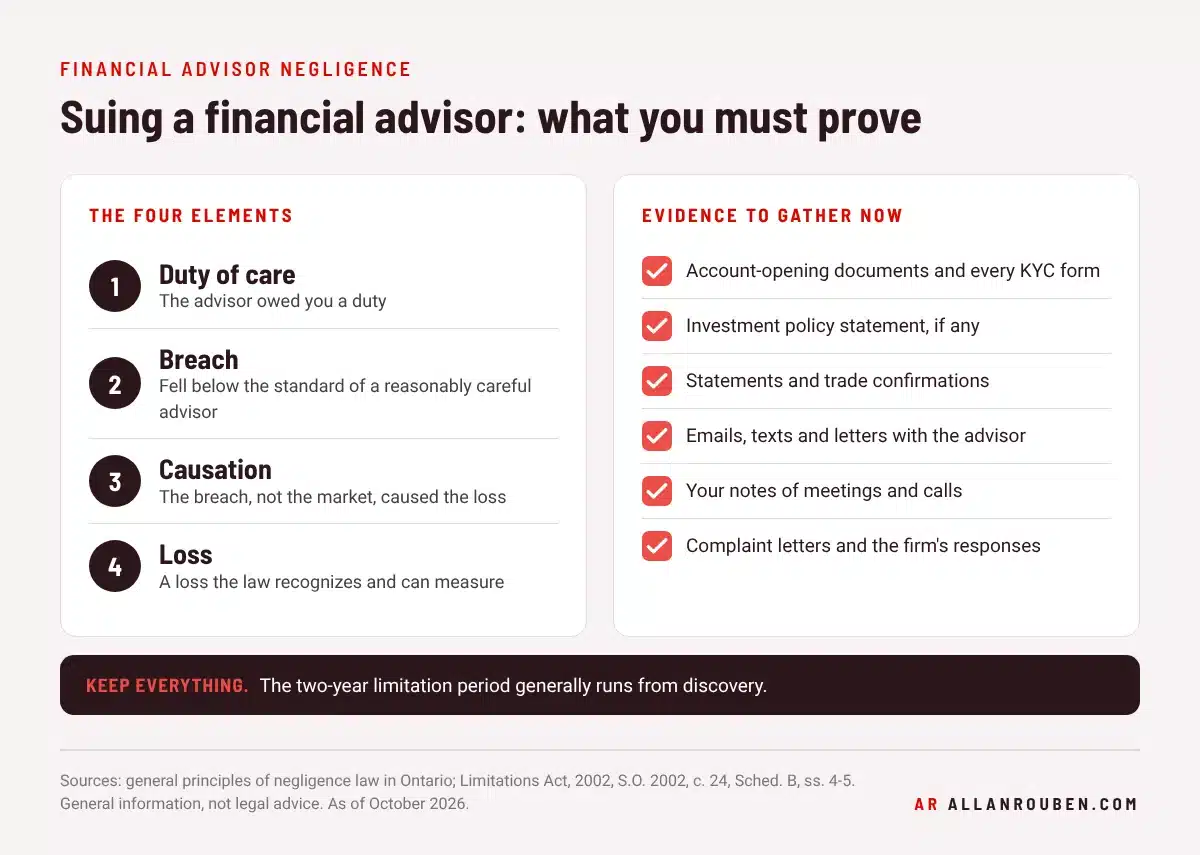
A negligence claim against an advisor rests on the same four elements as any negligence case. Our article on how to prove negligence covers them in more depth.
- Duty of care: the advisor owed you a duty. With a client relationship, this is rarely in dispute.
- Breach: the advisor fell below the standard of a reasonably careful advisor in the same position.
- Causation: the breach, not the market or your own choices, caused the loss.
- Loss: you suffered a loss the law recognizes and can measure.
The evidence usually decides these questions. Start gathering it now:
- Account-opening documents and every KYC form or update
- Any investment policy statement
- Monthly or quarterly statements and trade confirmations
- Emails, texts and letters with the advisor or firm
- Your own notes of meetings and calls
- Any complaint letters already sent, and the firm’s responses
Do not throw anything away, and do not send the advisor a detailed account of your case before you have spoken with a lawyer.
What losses can you recover?
The aim of damages is to put you in the position you would have been in if the advisor had done the job properly. That usually involves some combination of the following.
- Lost capital: the money actually lost on the unsuitable or unauthorized investments.
- Lost opportunity: in some cases, what a suitable portfolio would likely have earned over the same period. For example, if your savings should have been in a conservative mix that held its value while the unsuitable holdings fell, the comparison is between those two paths, not between your loss and zero.
- Reductions for your own conduct: a court can reduce damages for contributory negligence if you also failed to act reasonably, for example by ignoring statements that showed obvious problems.
- Mitigation: once you know about a problem, you are generally expected to take reasonable steps to limit further loss. What is reasonable depends on what you knew and how much you relied on the advisor.
Because damages depend on what you actually lost, an investment that later recovered can reduce the claim.
Where these claims are hard to win
Not every loss makes a strong claim. Common weaknesses include:
- Signed KYC forms showing a high risk tolerance or speculative objectives
- An experienced investor who reviewed and approved each trade
- A long delay after the problems were obvious from the statements
- An order-taking account where you chose the investments yourself
- Losses that simply track the broader market
None of these automatically ends a claim. A KYC form you did not read or understand, for example, may carry less weight than it appears. A lawyer’s first job is often to test these weaknesses against the documents before anything is filed.
How long do you have to sue a financial advisor?
Under the Limitations Act, 2002, the basic limitation period is two years from the day the claim was discovered (s. 4). Discovery means the day you knew, or the day a reasonable person in your circumstances ought to have known, about the loss, its cause, who caused it, and that a lawsuit was an appropriate remedy (s. 5). There is also an ultimate limit of 15 years from the act or omission (s. 15(2)). Our article on how long you have to sue for negligence in Ontario explains discoverability in detail.
The practical trap: do not assume that complaining to the firm stops the clock. Months spent in the firm’s internal complaint process can use up part of your two years. If you go to the Ombudsman for Banking Services and Investments (OBSI), the period is paused only from the date OBSI receives your signed consent letter, not from the day you first complained to the firm.
Complaint or lawsuit?
You can complain to your firm, take an unresolved complaint to OBSI, or report the advisor to the Canadian Investment Regulatory Organization (CIRO). These routes do different things: a firm or OBSI may offer or recommend compensation, while CIRO can discipline advisors but cannot order a firm to repay you. A lawsuit is the route where a court can award damages. For a side-by-side comparison, see our guide on whether to file an OBSI complaint or lawsuit.
When to speak to a lawyer
It is worth getting advice early if any of these apply:
- The loss is significant relative to your savings or retirement plans.
- The firm has rejected your complaint or offered far less than you lost.
- You found KYC documents you do not recognize or that misstate your situation.
- Trades were made without your instructions.
- You are getting close to two years from when you first noticed the problem.
If your concern is tax or accounting advice instead, see our article on suing an accountant for negligence.
Frequently asked questions
Can you sue a financial advisor for bad advice?
Yes, if the advice fell below the standard of a reasonably careful advisor and that failure caused your loss. Bad results alone are not enough, because suitable investments can still lose money. The strongest claims usually involve advice that did not fit your objectives, risk tolerance or financial situation, or risks that were not explained to you.
Can I sue my financial advisor for losing money?
Not for ordinary market losses on investments that were suitable for you. You may have a claim if the losses came from unsuitable investments, trades made without your authority, misrepresented risks, or conflicts of interest that were not addressed in your interest. The key question is whether the advice, rather than the market, caused the loss.
Do financial advisors have a fiduciary duty in Canada?
Not automatically. Under the Supreme Court of Canada’s decision in Hodgkinson v. Simms, an advisor can be a fiduciary depending on the trust, reliance, vulnerability and discretion in the particular relationship. Advisors still owe regulatory duties such as suitability and know your client, and a duty of care in negligence, whether or not they are fiduciaries.
What is the know your client rule?
The know your client rule, in section 13.2 of National Instrument 31-103, requires registered firms and advisors to gather and keep current information about you, such as your financial situation, investment objectives, risk tolerance and financial ability to withstand losses. That information is the foundation for deciding whether an investment is suitable for you.
How long do I have to sue my financial advisor in Ontario?
Generally two years from the day you discovered, or reasonably ought to have discovered, the claim, under the Limitations Act, 2002. There is also an ultimate limit of 15 years from the act or omission. Do not assume that time spent complaining to your firm pauses the two-year period; get advice early.
This article is general information about Ontario law as of October 2026, not legal advice. Your options depend on your facts and documents.
If you believe a financial advisor’s negligence cost you money, Allan Rouben offers a no-cost consultation to review your account documents and explain your options. With over 35 years of experience, Allan can help you understand whether your loss is a market loss or a claim worth pursuing. Book a free consultation or use the form below.