
The main red flags when hiring a lawyer are a guaranteed result, a fee arrangement that is not in writing, no clear answer about who will do the work, slow replies before you have even signed, no conflict check, pressure to sign at the first meeting, and a lawyer who takes on work outside their experience without saying so. Each connects to a Law Society of Ontario rule or a remedy you can use. Before you sign, check the lawyer’s licence, read the retainer in full, and get every promise about fees and communication in writing.
What follows takes each of the red flags when hiring a lawyer in turn, then sets out the short due-diligence process I would want anyone to run before retaining a civil litigation lawyer in Ontario, including me.
Red flags when hiring a lawyer, and what is just a lawyer being blunt
A lawyer who tells you your case is weak, that the number you have in mind is unrealistic, or that they will not take the file is not showing you a red flag. A lawyer who tells you it is a sure thing is. The warning signs below are about how the lawyer works, not their personality: communication, fees, who does the work, conflicts and competence.
They guarantee you a result
Under the Law Society of Ontario’s Rules of Professional Conduct, r. 4.2-1, a lawyer may market legal services only if the marketing “is demonstrably true, accurate and verifiable” and is not misleading. Commentary [2](a) to that rule adds that stating an amount recovered for a client, or referring to a degree of success in past cases, may breach the rule unless it comes with a statement that past results are not necessarily indicative of future results.
In plain terms: a large settlement figure on a billboard or homepage tells you about someone else’s facts, not yours. The same commentary also flags marketing that raises expectations.
A competent assessment gives you a range of possible outcomes, the specific risks in your file, what the other side will likely argue, and what happens if it goes badly.
The fee arrangement is vague, verbal, or moves
Rule 3.6-1 of the Rules of Professional Conduct says a lawyer shall not charge or accept a fee or disbursement unless it is “fair and reasonable and has been disclosed in a timely fashion.” In practice, the retainer agreement should set out, before any work starts:
- the hourly rate for every person who will work on the file
- an estimate of disbursements
- the retainer amount and what triggers a request to top it up
- how often you will receive an account
- what happens to retainer money that is not used
If you later think an account is too high, know where to go. The Law Society does not set legal fees and states on its complaints about legal fees page that it cannot reduce a lawyer’s bill. Instead, you can have the bill assessed by an Assessment Officer of the Superior Court of Justice under the Solicitors Act. Start within one month of receiving the bill, or you will need a judge’s permission. After twelve months from delivery, or once the bill is paid, an assessment is generally available only in special circumstances.
One limit worth stating: a higher hourly rate is not a red flag. A rate that was never written down is.
You cannot find out who is actually doing the work
Ask this, word for word: “Who will be drafting this, who will be at the hearing, and what do they each bill?”
Files move to junior lawyers and clerks for good reasons, often cost. The problem is a file that moves quietly and is still billed as if the senior lawyer were doing the work. With a sole practitioner, you get the lawyer you hired; a larger firm offers depth and cover when someone is away. The red flag is not the model; it is not being told which one you are buying.
Communication is already slow, before they have your money
How quickly did you get a reply while you were still deciding? That is usually a lawyer’s best behaviour. Rule 3.2-1 requires courteous, thorough and prompt service, and its commentary [6] says a lawyer should be prompt in responding to communications and reporting developments, and should keep in contact to the extent the client reasonably expects, even when nothing is happening.
Get in writing: your day-to-day contact, a reasonable response time, how often you will hear when there is no news, and email confirmation of significant decisions. A simple test: you should never learn that your motion date has moved from opposing counsel before you hear it from your own lawyer.
No conflict check, or a vague answer about conflicts
Rule 3.4-1 says a lawyer shall not act, or continue to act, where there is a conflict of interest, except as the rules permit. A real conflict check happens before the merits are discussed in any depth: the firm asks for the full legal names of the other parties, related companies, and sometimes key witnesses. A conflict found later can mean the lawyer has to stop acting partway through your file, at your cost.
Pressure to sign at the first meeting
Watch for a retainer agreement put in front of you for signature on the spot, a discount that expires today, or discouragement from getting a second opinion. You are entitled to take the retainer home, read it, and ask for changes.
There is one important exception. Where a limitation period or an appeal deadline is close, the urgency is real. A good lawyer will name the exact deadline and explain why it matters. Urgency tied to a date is advice; urgency tied to a discount is sales.
They are outside their depth and will not say so
Rule 3.1-2 requires a lawyer to perform legal services to the standard of a competent lawyer. Commentary [6] says a lawyer must recognize a task they lack the competence to handle, and should then decline to act or, with the client’s instructions, bring in a licensee who is competent for that task.
Appeals are a common example. The lawyer who ran your trial or argued your motion is not automatically the right person for the appeal. Appellate work uses different skills, turns on the written record, and runs on short, firm deadlines. A lawyer who suggests bringing in a Toronto appeal lawyer is meeting their professional obligations, not failing you. That is the standard to hold anyone to, including me.
The question to ask: “How many matters like this have you handled in the last five years?”
How to verify a lawyer before you sign anything
Spotting red flags when hiring a lawyer is half the job. The other half is checking the basics yourself:
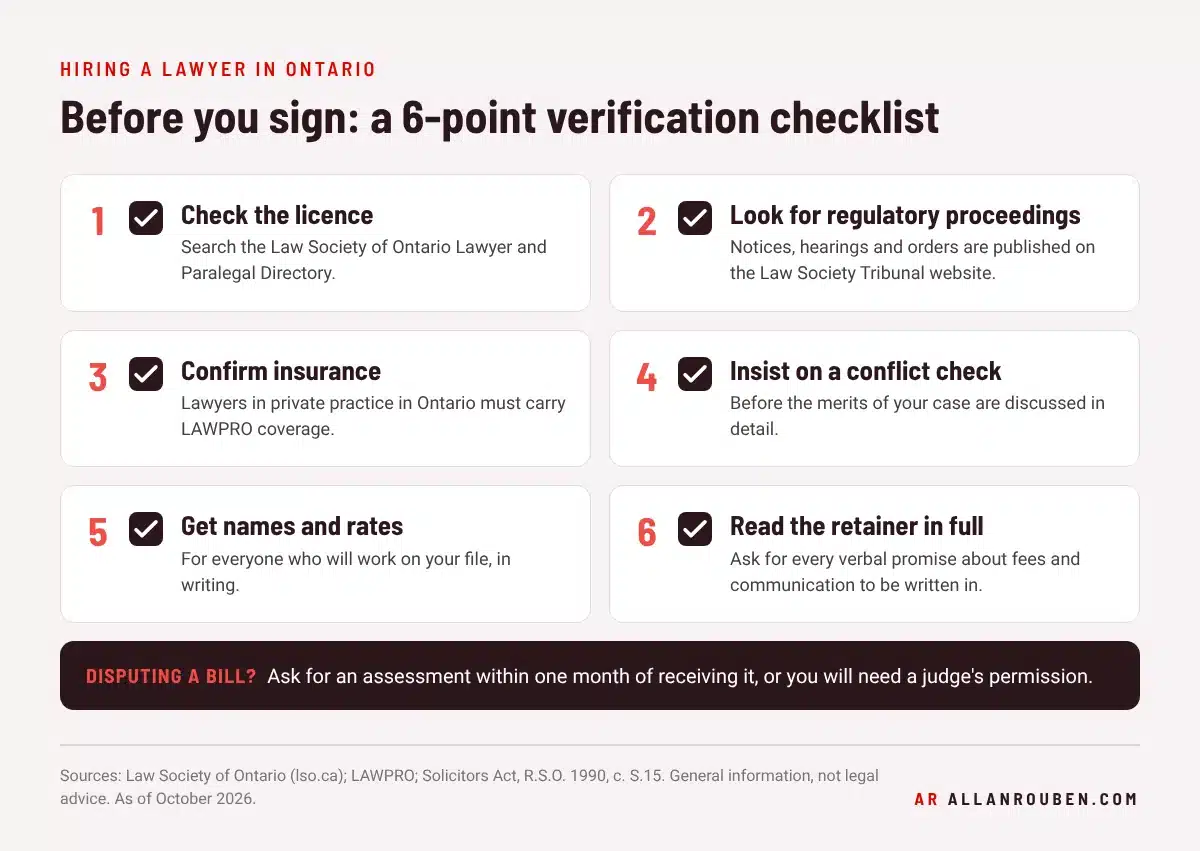
- Check the licence. Search the Law Society of Ontario Lawyer and Paralegal Directory to confirm the lawyer is licensed in Ontario and to see their status and contact information.
- Look for regulatory proceedings. The Law Society’s current regulatory actions page explains that notices, hearings, orders and reasons are published on the Law Society Tribunal website.
- Confirm insurance. Lawyers in private practice in Ontario must carry professional liability coverage through LAWPRO.
- Insist on a conflict check before you discuss the merits in detail.
- Get names and rates for everyone who will work on your file.
- Read the retainer in full before signing, and ask for anything you were told verbally to be written into it.
What to do if you are already with the wrong lawyer
The Law Society’s complaints page suggests trying to resolve the problem with the lawyer first. Options, from least to most drastic:
- Put your concern to the lawyer in writing.
- Ask for a detailed account showing who did what, and when.
- If the issue is the bill, apply for an assessment, watching the one-month window described above.
- If the issue is conduct, make a complaint to the Law Society, as soon as possible.
- Change lawyers.
Changing counsel has real costs. The new lawyer has to learn the file at your expense, and a change close to a hearing date can affect the case itself. It is usually still worth it when trust has broken down or a deadline is being missed. It is usually not worth it over one slow reply. Our post on whether you can change lawyers in the middle of a case covers the mechanics.
Poor service and negligence are not the same thing. If a lawyer’s error has caused you an actual loss, read what counts as professional negligence and our guide to suing a lawyer for negligence, or speak with a professional negligence lawyer. Limitation periods apply, generally two years from when the claim was discovered, so check how long you have to sue sooner rather than later.
Frequently asked questions
What is the most common complaint against a lawyer?
In practice, communication and billing are among the most common friction points between clients and lawyers: calls that go unreturned, decisions that are not explained, and accounts that come as a surprise. That is why the Law Society’s own rules expect lawyers to respond promptly to communications and to report developments to clients.
What are red flags for lawyers when they take on a client?
Lawyers screen clients too. Common concerns include expectations that no evidence could support, several previous lawyers on the same file, reluctance to disclose unhelpful facts or documents, and choosing purely on price. Knowing them makes you a better client: share bad facts early, bring your documents, and be candid about lawyers you have already consulted.
What questions should I ask a lawyer before hiring them?
- Who will work on my file, and what does each person bill?
- What is a realistic range for the total cost?
- What are the weaknesses in my case?
- What does the timeline look like, and which deadlines matter most?
- How and how often will you update me?
How much does hiring a lawyer cost in Ontario?
It depends on the matter. Hourly billing is common in litigation. Flat fees tend to suit defined tasks. Contingency arrangements tie the fee to the outcome. Whatever the structure, it belongs in the written retainer before work begins. If you later dispute an account, you can ask the Superior Court’s Assessment Office to review it, ideally within one month of receiving the bill.
Is hiring a lawyer worth it?
Not always. For a small, simple money claim, Small Claims Court exists so people can proceed without a lawyer; its limit is $50,000 under O. Reg. 626/00. The balance shifts with complexity, an opponent who has counsel, a looming limitation or appeal deadline, or a claim that threatens your business.
This article is general information about Ontario law as of October 2026, not legal advice. Your options depend on your facts and documents.
The red flags when hiring a lawyer apply to every lawyer you meet. Every question in this post is one you are entitled to ask me too. If you are weighing a dispute or unsure about your current lawyer, I offer a free consultation drawing on over 35 years of experience. Book a consultation or use the form below.