
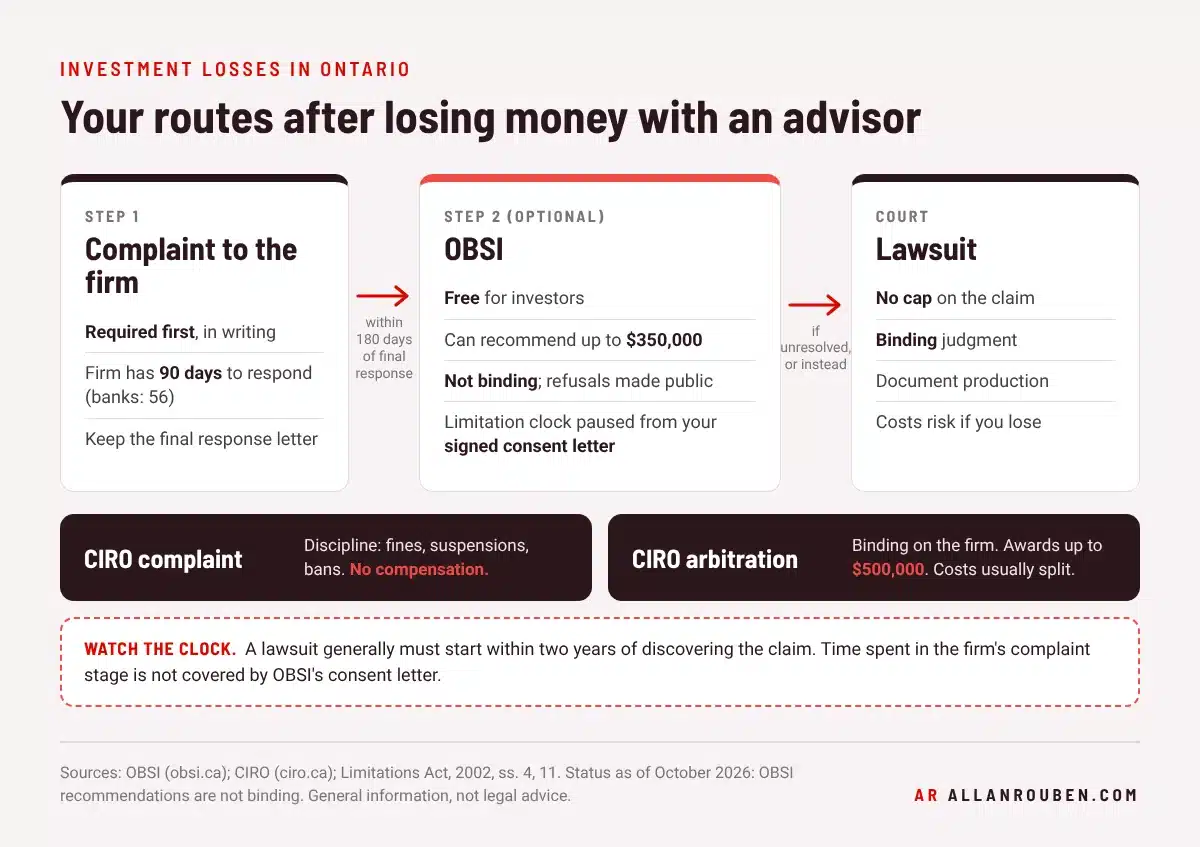
If you lost money with an investment advisor in Ontario, you usually have four routes. The first is a written complaint to the firm, which must come first. The second is a free OBSI complaint: the Ombudsman for Banking Services and Investments can recommend up to $350,000, but its recommendation is not binding. The third is a CIRO complaint, which can lead to discipline of the advisor but cannot order the firm to pay you. The fourth is a lawsuit, which has no cap and ends in a binding judgment, but carries cost and risk. CIRO also runs a separate arbitration program, with awards up to $500,000.
| Route | Cost to you | Maximum recovery | Binding? | Who decides | Time limit to start |
|---|---|---|---|---|---|
| Complaint to the firm | Your time | Whatever the firm offers | No; you can refuse an offer | The firm | Required first step; the firm has 90 days to respond (56 days for banks) |
| OBSI complaint | Free | Up to $350,000 per complaint | No (a firm’s refusal is made public) | OBSI recommends | 180 days after the firm’s final response |
| CIRO complaint | See below | None: CIRO cannot order compensation | Not a compensation route | CIRO (discipline only) | Varies |
| CIRO arbitration | Costs usually split equally between both sides | Up to $500,000 | Yes, firms must comply | An arbitrator | Varies |
| Small Claims Court | Varies | Up to $50,000 | Yes (court judgment) | A judge | Generally two years from discovery |
| Superior Court of Justice | Varies, plus risk of paying costs if you lose | No cap | Yes (court judgment) | A judge | Generally two years from discovery |
These routes are not mutually exclusive, and the order you take them in matters because of deadlines. If your question is whether you have a claim at all, start with can I sue my financial advisor, which covers what you have to prove. This post is about which route to take. A professional negligence lawyer can help you weigh them against your own documents.
Step one: complain to the firm in writing
OBSI will not look at your file until the firm has had a chance to deal with it. Write to the firm’s complaints department, not only to your advisor, and keep a copy of everything you send and receive.
A useful complaint letter includes:
- your name and account numbers;
- the investments involved and the dates of the trades or advice;
- what you say went wrong, in plain terms;
- the loss you are claiming and how you calculated it; and
- what you want the firm to do.
According to OBSI, investment firms have 90 days to respond to your complaint, and banks have 56 calendar days. For Quebec residents the period is 60 days, which can be extended to 90. Keep the firm’s final response letter. It starts the next clock.
What is OBSI, and how does an OBSI complaint work?
The Ombudsman for Banking Services and Investments (OBSI) is an independent service that investigates complaints against participating banks and investment firms. It is free for consumers and investors.
Once you receive the firm’s final response, you have 180 calendar days to bring an OBSI complaint. OBSI investigates and then makes a recommendation. If the firm refuses to follow it, OBSI makes that refusal public. Your name is not mentioned.
What is the OBSI compensation limit?
As of October 2026, OBSI can recommend up to $350,000 for a single complaint, and the limit does not increase when more than one account is involved. If your loss is larger, you either accept that OBSI can only recommend part of it, or you look at a route without that ceiling.
Is an OBSI decision binding?
No. As of October 2026, OBSI’s recommendations are not binding, and a firm is not required to follow them. If a firm refuses, OBSI makes that refusal public.
Status as of October 2026: The Canadian Securities Administrators (CSA) proposed a binding-authority framework for OBSI on November 30, 2023, and refined it in CSA Notice 25-314 (July 15, 2025), which proposed binding decisions for compensation up to $350,000. The CSA noted that many provinces would need legislative amendments. An independent review of OBSI released July 22, 2026 recommended binding authority and a $550,000 limit with inflation indexing. None of this is in force. Check OBSI’s site for the current position before you rely on it.
What a CIRO complaint can and cannot do
The Canadian Investment Regulatory Organization (CIRO) oversees investment dealers and their advisors. A CIRO complaint is about conduct. CIRO can investigate and take disciplinary action, including fines, suspensions or permanent bans. What it cannot do is compensate you or force a firm or advisor to reimburse you.
CIRO’s arbitration program is a separate compensation option. Under its arbitration program, arbitrators can award up to $500,000, and investment firms must comply with arbitration decisions. A few points to know before you choose it:
- It is not free. Costs such as filing fees and the arbitrator’s hourly rate are usually split equally between both sides.
- ADR Chambers administers it everywhere in Canada except Quebec, and you contact the administrator directly.
- You name the firm. Individual advisors cannot be named as respondents.
CIRO has proposed raising the award limit to $1,000,000, but as of October 2026 we have not found any approval or effective date, so treat $500,000 as the limit.
A CIRO complaint still makes sense alongside another route, when you want the advisor’s conduct on the regulator’s record. Just do not expect it to put money back in your account.
Suing your advisor or investment firm
Which court hears your claim depends on its size. Small Claims Court handles claims up to $50,000, a limit set by O. Reg. 626/00 since October 1, 2025. Larger claims go to the Superior Court of Justice, where the simplified procedure applies to claims of $200,000 or less, excluding interest and costs (Rule 76.02(1)).
A lawsuit gives you three things the other routes do not:
- No cap. You can claim the full loss you can prove.
- A binding result. A judgment is enforceable, not a recommendation.
- Document production. Each party must disclose every relevant document in its possession, control or power, which matters when the records sit with the firm.
It also costs more. You pay legal fees, the process takes time, and if you lose, you may have to pay part of the other side’s legal costs. If you have not been through a court case before, how a civil lawsuit works in Ontario walks through the stages. If the advisor’s role went beyond advice into a position of trust, a breach of fiduciary duty claim may also be worth discussing.
Does an OBSI complaint stop the limitation clock?
Partly. In Ontario, you generally have two years from the day you discovered the claim to start a lawsuit. That is the limitation period for negligence in Ontario. An OBSI complaint can pause that clock, but only from a specific date.
According to OBSI, firms that participate in OBSI are required to enter a tolling agreement with you “to the extent permitted by law”. Under OBSI’s consent letter:
- the clock stops when OBSI receives your signed consent letter;
- it starts again 30 days after OBSI’s final letter to you, or when the investigation ends, whichever comes first; and
- it does not revive a limitation period that has already expired, or start a new one.
The statute behind this is section 11 of the Limitations Act, 2002. It suspends the two-year period while the parties “have agreed to have an independent third party resolve the claim or assist them in resolving it,” until the claim is resolved, the process ends, or a party withdraws.
Here is the trap. The OBSI consent letter starts the pause when OBSI receives it. It does not reach back to cover the months you spent in the firm’s own complaint process. If the firm took its full 90 days and you then waited months before going to OBSI, that time may already have come out of your two years. Do not assume your clock was paused while the firm considered your complaint. If you are close to the deadline, get advice before you sign anything or wait any longer.
When a lawsuit makes more sense than OBSI
Going straight to court, or moving to court after OBSI, is worth considering when:
- your loss is well above $350,000;
- the firm has refused an OBSI recommendation, or has signalled that it will;
- more than one party may be responsible, such as the advisor, the firm and another professional;
- the facts suggest serious misconduct rather than a single poor recommendation;
- the two-year limitation period is close; or
- the key evidence sits with the firm and will need to be produced.
If you have already started a lawsuit and then go to OBSI, you must agree not to proceed with the lawsuit until OBSI has completed its review.
When OBSI is the sensible first step
For a smaller, clearly documented loss, a free process with no risk of paying the firm’s costs can be the right first move. You keep your right to take legal action after OBSI completes its work if you do not agree with the outcome. Signing the consent letter promptly also starts the tolling agreement, which protects the time you have left. The choice is less about which route is better in general and more about the size of your loss, the strength of your documents, and how much time remains on your clock.
Frequently asked questions
How do I file a complaint against a financial advisor in Ontario?
Start with a written complaint to the firm’s complaints department, setting out the accounts, dates, what went wrong and the loss. Investment firms have 90 days to respond; banks have 56. Within 180 days of the firm’s final response, you can file an OBSI complaint, which is free. A separate CIRO complaint addresses the advisor’s conduct, not compensation.
Is an OBSI decision binding?
No. As of October 2026, OBSI recommendations are not binding, and a firm that refuses one is publicly named, without naming you. The CSA has proposed binding decisions up to $350,000 (CSA Notice 25-314, July 2025), and a July 2026 independent review recommended binding authority, but none of these changes is in force.
Can I sue after going to OBSI?
Yes. OBSI states that you do not give up your right to take legal action against your firm after it completes its work. Your limitation clock is paused from the date OBSI receives your signed consent letter and restarts 30 days after OBSI’s final letter or when the investigation ends, whichever comes first. Time before OBSI involvement is not covered by that letter.
Can CIRO get my money back?
No. CIRO can discipline advisors and firms, including fines, suspensions and permanent bans, but it cannot compensate you or force a firm to reimburse you. CIRO does run a separate arbitration program where an arbitrator can award up to $500,000 against the firm, with costs usually split between both sides. Firms must comply with those decisions.
What is the OBSI compensation limit?
As of October 2026, OBSI can recommend up to $350,000 for a single complaint, and the amount does not increase when more than one account is involved. A July 2026 independent review recommended raising the limit to $550,000 with inflation indexing, but that change has not been made. Larger losses may belong in court.
This article is general information about Ontario law as of October 2026, not legal advice. Your options depend on your facts and documents.
If your loss is above the OBSI limit, your firm has refused to pay, or you are unsure how much time is left on your limitation period, Allan Rouben can review your situation. Allan has over 35 years of experience. Book a free consultation to talk through your options.