
Most of the decisions that decide how a commercial dispute ends are made before anything is filed. Good commercial dispute resolution starts with five steps: preserve the documents, work out which limitation clock is already running, read the dispute resolution clause in your own contract, choose the forum on purpose, and price the fight against what you are actually owed. Owners who skip them often find the case was shaped by an angry email, a deleted text thread or a missed deadline.
The first thirty days shape the case more than the trial does
Consider two owners with the same unpaid account. The first forwards a furious email to the customer in week one. That email is now a document the other side will read back later. The second writes a short, dated note to file setting out what was promised, what was delivered and when payment stopped. That note is evidence for the owner, made while memories are fresh.
The claim is the same. The record is not. Effective commercial dispute resolution is mostly about protecting that record early. Below are the five things worth doing in that window, then two later decisions: whether the case can survive an appeal, and whether to litigate at all. If you want the wider picture first, our overview of how civil litigation works in Ontario sets out the stages, and a commercial litigation lawyer in Toronto can help you apply them to your facts.
Preserve the documents, and stop the informal tidying up
In a business dispute, the documents usually matter more than anyone’s recollection. Be broad about what counts:
- email, text messages, and WhatsApp or Signal threads
- accounting records, invoices, purchase orders and delivery records
- drafts of the contract and the negotiation correspondence
- internal notes, meeting minutes and calendar entries
Then tell your staff to stop deleting. A short written instruction to the people who hold the records is the practical version of a litigation hold, and you can send it on day one without a lawyer. Pay particular attention to what is easy to lose: phones that are about to be replaced, cloud accounts set to auto-delete, and the mailboxes of employees who are leaving.
There is also a legal reason. In a Superior Court action, rule 30.02(1) of the Rules of Civil Procedure requires every document relevant to an issue in the action that is in a party’s possession, control or power to be disclosed, whether or not privilege is claimed over it. Destroying relevant records once a dispute is in view can seriously damage a party’s position, and it rarely makes the underlying problem go away.
Find out how much time you actually have
The general rule is in section 4 of the Limitations Act, 2002: a proceeding cannot be commenced after the second anniversary of the day the claim was discovered. The word that matters is “discovered.”
Section 5 says a claim is discovered on the earlier of two days. The first is the day you first knew that the loss occurred, that it was caused or contributed to by an act or omission, who was responsible, and that a proceeding would be an appropriate way to remedy it. The second is the day a reasonable person in your circumstances ought to have known those things. The Act also presumes you knew on the day the act or omission took place, unless the contrary is proved. “The day I got angry about it” is not the test.
A worked example. An invoice goes unpaid in March 2025. The customer keeps promising payment through the summer, then stops answering in November. Which date counts? It could be March, when the loss occurred, or later, depending on whether the promises affected when a lawsuit became an appropriate remedy. The answer is fact-specific, so work from the earliest date. Section 15(2) adds an outer limit: no proceeding can be brought more than 15 years after the act or omission, whether or not the claim was ever discovered.
Check your contract, don’t assume two years
Business owners should be especially careful here. Under section 22(5), a business agreement made on or after October 19, 2006 can vary or exclude the basic two-year period, which means your contract may give you less time. Section 22(3) allows the parties to suspend or extend a limitation period by agreement. And under section 11, time stops running while the parties have agreed to have an independent third party, such as a mediator, resolve the claim or help them resolve it. Contracts may also impose notice requirements and cure periods. Read the agreement and get advice on your actual deadline.
Read your own dispute resolution clause before you do anything else
The clause is usually near the end of the agreement, and it governs everything that follows. Look for these points, in this order:
- Is there a mandatory arbitration clause?
- Is mediation or a senior-management meeting a precondition to any proceeding?
- What governing law and jurisdiction does the contract choose?
- Is there a notice-of-default provision with a cure period?
The expensive mistake is starting a court action in the face of a binding arbitration clause. The other side brings a motion to have the action stayed, and you pay for a procedural fight before the real dispute has begun. Skipping a required notice step can cause similar problems. If the dispute is with a co-owner rather than a customer, the partnership or shareholder agreement plays the same role; our post on partnership disputes covers that situation.
Choose the forum for commercial dispute resolution deliberately
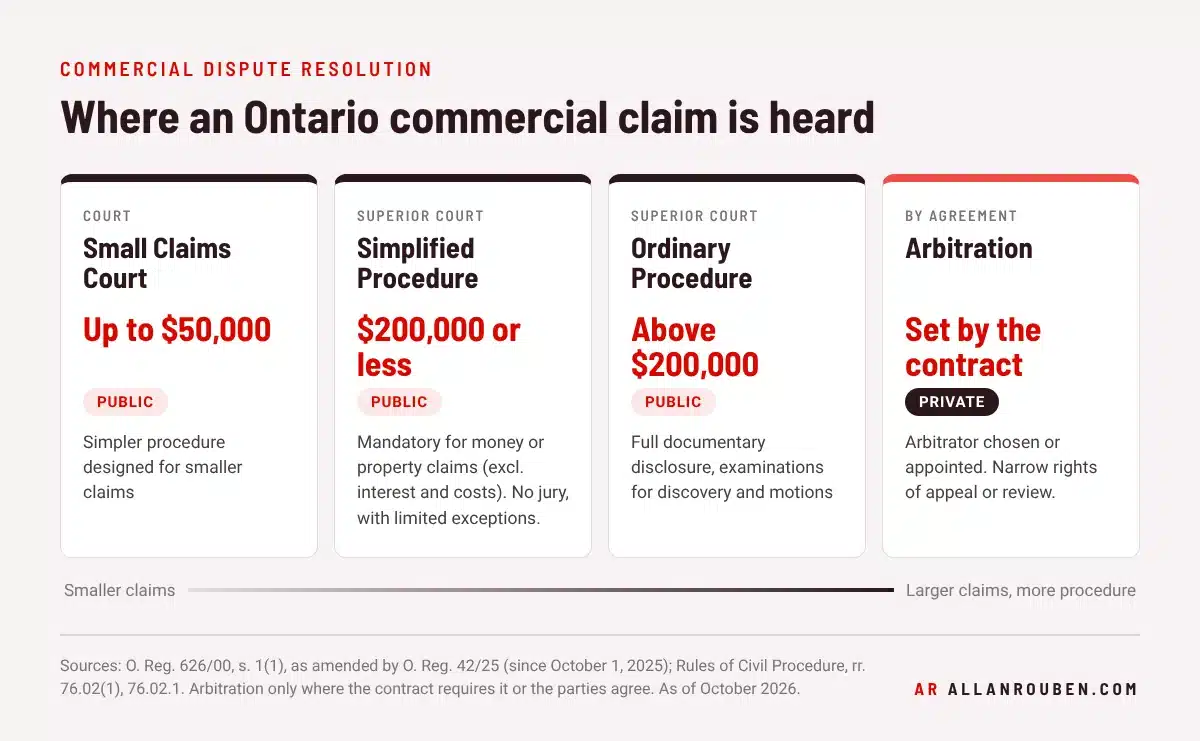
In Ontario, the size of the claim largely decides which court process applies, unless the contract requires arbitration. Many online articles still quote an old Small Claims limit, so the table cites the rules you can check yourself.
| Forum | Monetary limit | How it runs | Privacy | Appeal or review |
|---|---|---|---|---|
| Small Claims Court | Up to $50,000 | Simpler procedure designed for smaller claims | Public | Appeal routes exist, subject to monetary thresholds |
| Simplified Procedure (Rule 76, Superior Court) | Mandatory for claims exclusively for money, real or personal property of $200,000 or less, exclusive of interest and costs | Streamlined Superior Court process; no jury except for slander, libel, malicious arrest, malicious prosecution and false imprisonment | Public | Ordinary appeal routes |
| Ordinary procedure (Superior Court) | Claims above the Simplified Procedure threshold | Full documentary disclosure, examinations for discovery and motions | Public | Ordinary appeal routes |
| Arbitration | Set by the contract or the parties’ agreement | Private process before an arbitrator the parties choose or appoint | Private | Narrow; often limited by the agreement |
The Small Claims maximum is set by O. Reg. 626/00, s. 1(1), and the increase to $50,000 took effect on October 1, 2025, as practicePRO reported. One point specific to companies: in the Superior Court, rule 15.01(2) requires a corporation to be represented by a lawyer unless the court grants leave. The Supreme Court of Canada has encouraged proportionate procedures tailored to the case in Hryniak v. Mauldin, 2014 SCC 7.
Arbitration is often chosen for its privacy. The trade-off is the limited route to appeal or review: if the arbitrator gets it wrong, you may have little recourse. That is a central feature, not a footnote.
Price the fight before you commit to it
Ontario civil litigation generally follows a loser-pays principle: the unsuccessful party is usually ordered to pay a portion of the successful party’s legal costs. That exposure runs in both directions. A claim you are confident about still carries the risk of paying the other side’s costs if it fails.
The most useful costs concept to understand early is the formal offer to settle under Rule 49. A written offer made in the proper form can change who pays costs from the date it was made, depending on how the result compares with the offer. Either side can use it, which makes it a strategic tool rather than a sign of weakness.
Then add the costs that rarely appear in a budget:
- management and staff time spent on documents, discovery and preparation
- disclosing your own records to a competitor or former partner
- the effect on financing, customer relationships and supplier confidence
- delay, which ties up money and attention
Think about the appeal before you think about the trial
An appeal is argued on the record made at first instance. It is not a second trial. If a point was not argued, an objection was not taken, or a finding was not asked for, the appeal court is generally limited to what the trial record contains.
That has two practical consequences for an owner. First, ask your lawyer early whether the issues that matter commercially, such as the interpretation of a key clause or the measure of damages, are being put in a way that would hold up on a commercial appeal. Second, do not treat a possible appeal as a safety net for an under-prepared trial. Issues are also shaped earlier by motions in civil litigation, so the record starts building long before the trial date.
When settling early is the better business decision
Even a strong case can be a bad trade. Litigating is often the wrong business decision when:
- the other side has no assets, so a judgment against an empty company is only paper
- the commercial relationship is worth more than the claim
- disclosure would put sensitive information in a competitor’s hands
- the management time it will consume exceeds the amount in dispute
- the reputational exposure falls much more heavily on you than on them
Settling early can be the mistake when the conduct is a pattern that will repeat, when the claim threatens the business itself, or when the other side will read an early offer as an invitation to take more. The differences between litigation and mediation are worth understanding before you decide.
A working heuristic for commercial dispute resolution: estimate what you would realistically collect, after the other side’s ability to pay, then subtract your own legal costs, your management time at a fair internal rate, and the costs risk if you lose. If what remains is small, or depends on everything going right, settle and move on. If what remains is substantial, or the dispute concerns the future of the company, prepare to litigate, and negotiate from that position.
Frequently asked questions
What is a business dispute?
A business dispute is a disagreement arising from commercial dealings that the parties cannot settle on their own. Common categories include contract disputes with customers or suppliers, conflicts between shareholders or partners, employment disputes, disputes over commercial real property, and professional negligence claims against advisers. Most turn on the contract and the documents.
How do you resolve a business dispute without going to court?
Commercial dispute resolution outside court usually means direct negotiation, mediation, arbitration, and any escalation steps your contract requires, such as a meeting between senior managers. Mediation resolves many commercial matters, but it works best once both sides have enough information to value the claim realistically. If the parties have agreed to mediate, section 11 of the Limitations Act, 2002 suspends the limitation period while that process is under way.
Why is arbitration preferable in a business dispute?
Sometimes it is, and sometimes it is not. Arbitration offers privacy, a choice of decision-maker with relevant expertise, and more control over scheduling. On the other side, the parties pay for the arbitrator and the process, rights of appeal or review are narrow, and an arbitrator generally cannot bind people who are not parties to the arbitration agreement. Weigh both lists against your dispute.
How long do I have to sue for breach of contract in Ontario?
The basic limitation period under the Limitations Act, 2002 is two years from the day the claim was discovered, subject to a 15-year ultimate limit. But a business contract can shorten or exclude that basic period, and discovery is fact-specific. Check your contract and get advice on your actual date. Our guide to suing for breach of contract in Ontario covers the claim itself.
Are the courts the best forum to resolve business disputes?
Sometimes. Court is often the better choice when a public record or precedent matters, when you need an injunction, or when the other side will not engage without compulsion. If you are the one being sued, time is short, so get advice as soon as you are served.
This article is general information about Ontario law as of October 2026, not legal advice. Your options depend on your facts and documents.
If a commercial relationship has started to go wrong, the next thirty days matter more than any later hearing. Allan Rouben has over 35 years of experience and can help you work out what to preserve, which deadline applies, and whether litigation makes business sense. Book a free consultation to talk through your situation.