
A fiduciary duty is a legal duty to act loyally in another person’s best interests. It arises automatically in some relationships, and in others where one person has undertaken to act for another and holds power over their interests. You can sue for breach of fiduciary duty in Ontario when a fiduciary puts their own interests ahead of yours, for example through self-dealing, an undisclosed conflict or a secret profit. You generally have two years from the day you discovered the claim to start a lawsuit.
This guide explains who owes the duty, what a breach looks like, what you would have to prove, what a court can order and where these claims tend to fall apart. If you suspect a partner, director, trustee or advisor has put themselves first, it may also help to speak with a civil litigation lawyer in Toronto early, while the documents are still easy to gather.
What is a fiduciary duty?
In short: a fiduciary duty is a strict legal duty of loyalty. A fiduciary must act in the best interests of the person they serve, avoid conflicts between their own interests and that person’s, make no secret profit from the relationship, and never use the other person’s property, information or trust for their own benefit without informed consent.
The distinction most people miss is that fiduciary duty is about loyalty, not competence. A careless advisor or professional may be negligent without being disloyal. A disloyal one can breach a fiduciary duty even when the outcome looks fine on paper. Negligence asks whether someone took reasonable care; breach of fiduciary duty asks whose interests they were serving. If your concern is a professional’s carelessness rather than their loyalty, our guide to suing a lawyer, or the advisor guide linked below, may be the better starting point.
Who owes a fiduciary duty in Ontario?
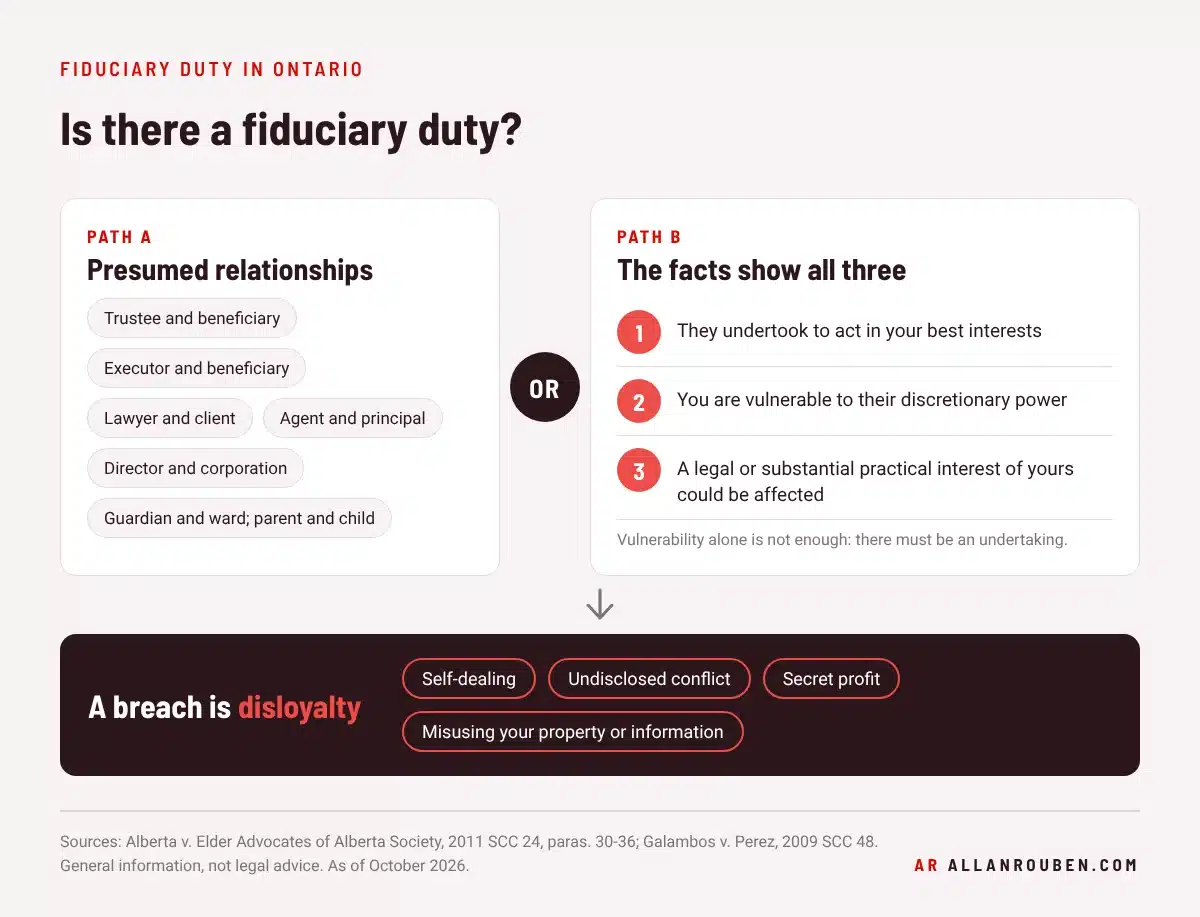
Courts recognize fiduciary duties in two ways: in categories of relationship where the duty is presumed, and in other relationships where the facts show the duty exists.
Relationships where the duty is presumed
Some relationships are treated as fiduciary by their nature. In Alberta v. Elder Advocates of Alberta Society, 2011 SCC 24 (para. 33), the Supreme Court of Canada listed the traditional categories:
- trustee and beneficiary
- executor (estate trustee) and beneficiary
- lawyer and client
- agent and principal
- director and corporation
- guardian and ward, or parent and child
Business partners also owe each other duties of disclosure and accounting, and in Ontario many of those duties are written into the Partnerships Act, discussed below.
When the duty arises from the facts
Outside those categories, a fiduciary duty can still arise on the facts. The Supreme Court of Canada set out the test in the same case. In plain terms, you need to show three things:
- An undertaking. The person gave, in the Court’s words, “an undertaking of responsibility to act in the best interests of a beneficiary” (para. 30).
- Vulnerability. You were vulnerable to them because they held a discretionary power over you.
- An interest at stake. Their power could affect a legal or substantial practical interest of yours.
The undertaking is the element people tend to overlook. In Galambos v. Perez, 2009 SCC 48, the Supreme Court made clear that vulnerability on its own is not enough. There must be an undertaking, express or implied, by the alleged fiduciary to act with loyalty toward you. Relying on someone, or being in a weaker position, does not by itself make them your fiduciary.
Common situations, briefly
Fiduciary claims come up in many settings. This section sketches the most common ones and points you to more detailed guides.
Business partners
Under Ontario’s Partnerships Act, partners must render true accounts and full information of all things affecting the partnership (s. 28), account to the firm for any benefit taken without the other partners’ consent from partnership transactions or from using partnership property, name or business connection (s. 29), and pay over all profits from a competing business carried on without consent (s. 30). These duties are often at the heart of partnership disputes, and they continue to matter when partners are dissolving a partnership.
Corporate directors and officers
Section 134(1)(a) of the Business Corporations Act (Ontario) requires every director and officer to “act honestly and in good faith with a view to the best interests of the corporation.” The Supreme Court has confirmed that this fiduciary duty is owed to the corporation itself (Peoples Department Stores Inc. (Trustee of) v. Wise, 2004 SCC 68; BCE Inc. v. 1976 Debentureholders, 2008 SCC 69). That is why a shareholder who feels wronged usually looks to other legal routes. Our article on shareholder disagreement covers those situations.
Estate trustees
Estate trustees (executors) owe fiduciary duties to the beneficiaries of the estate. Claims involving estates can also carry their own, shorter deadlines: for example, a claim against a deceased person’s estate must generally be brought within two years of the death (Trustee Act, s. 38(3)). If an estate is involved, get advice early. See also our page on estate litigation.
Financial advisors
Financial advisors are not automatically fiduciaries in Canada. In Hodgkinson v. Simms, [1994] 3 S.C.R. 377, the Supreme Court held that an advisor can owe a fiduciary duty depending on the relationship, looking at factors such as trust and confidence, reliance, vulnerability and the advisor’s discretion. Separately, the securities regulators’ Client Focused Reforms introduced best-interest requirements for addressing material conflicts of interest (s. 13.4 of NI 31-103) and a suitability rule requiring that an investment action put “the client’s interest first” (s. 13.3). An overarching statutory best-interest standard, however, was not adopted (see the CSA’s summary of the reforms). Our guide on suing a financial advisor covers these claims in more depth.
Lawyers
Lawyers owe fiduciary duties to their clients, including a duty to avoid conflicts of interest, alongside their duty to act competently. The guide on suing a lawyer linked above explains how these claims usually proceed.
What counts as a breach?
A breach of fiduciary duty is a failure of loyalty. The common patterns include:
- Self-dealing: a trustee sells estate property to a company they control.
- Undisclosed conflicts of interest: an advisor recommends a product without telling you they benefit from the sale.
- Secret profits or commissions: an agent takes a side payment on a deal they negotiated for you.
- Misusing property or information: a partner uses the firm’s client list to build a business of their own.
- Serving competing interests without consent: a director quietly acts for a rival in a transaction with the corporation.
Many of these allegations turn on disclosure and consent. If the fiduciary told you about the conflict or the benefit in full, and you agreed with your eyes open, that can be an answer to the claim. The Partnerships Act reflects the same idea: ss. 29 and 30 apply to benefits and competing businesses taken “without consent.”
What you have to prove
Suing for breach of fiduciary duty in Ontario generally means establishing:
- A fiduciary relationship existed, either because it falls into a presumed category or because it meets the Elder Advocates test.
- The fiduciary breached the duty of loyalty, for example by self-dealing, an undisclosed conflict or a secret profit.
- The consequences, meaning the loss you suffered, the gain the fiduciary made, or both.
Evidence matters in these cases, and much of it sits with the other side. Start gathering what you can now: agreements and engagement letters, partnership or shareholder agreements, corporate records and minutes, bank and investment account statements, emails and texts, and anything that shows what the fiduciary knew and what they disclosed to you. Keep originals, and write down a timeline while your memory is fresh.
What remedies can a court order?
Remedies for breach of fiduciary duty come mainly from equity, and the court chooses the one that fits the wrong. The main options are:
| Remedy | What it does |
|---|---|
| Equitable compensation | Money aimed at restoring you to the position you would have been in had the duty not been breached. Recovery is limited by causation: in Canson Enterprises Ltd. v. Boughton & Co., [1991] 3 S.C.R. 534, losses caused by others’ conduct, not by the breach, were not recoverable. |
| Accounting and disgorgement of profits | Requires the fiduciary to account for profits made from the breach and give them up. |
| Constructive trust | Treats specific property obtained through the breach as held for your benefit. |
| Rescission | Sets aside a transaction tainted by the breach and, as far as possible, returns the parties to where they started. |
| Injunction | A court order stopping ongoing conduct, such as continued use of confidential information or property. |
How long do you have to sue for breach of fiduciary duty in Ontario?
For most claims, Ontario’s Limitations Act, 2002 sets the deadline. The basic rule in s. 4 is that a proceeding cannot be started after the second anniversary of the day the claim was discovered. Discovery is the day you knew, or reasonably ought to have known, about the loss, its cause, who caused it, and that a lawsuit would be an appropriate way to address it (s. 5).
There is also an ultimate limit: no proceeding after the 15th anniversary of the act or omission the claim is based on (s. 15(2)). That 15-year period does not run while the defendant wilfully conceals the loss, its cause or their identity, or wilfully misleads you about whether a lawsuit is appropriate (s. 15(4)(c)). Fiduciary breaches are often hidden, so that rule can matter. Claims involving a deceased person’s estate may face the shorter Trustee Act deadline mentioned above.
For a fuller explanation of discovery and how the clock runs, see our guide to limitation periods in Ontario.
Where fiduciary claims fall apart
Not every disappointing relationship is a fiduciary one. Claims commonly fail for these reasons:
- No undertaking. Two businesses dealing at arm’s length, each looking after itself, usually do not owe each other fiduciary duties.
- Careless, not disloyal. Poor work or bad advice may be negligence or breach of contract, but it is not a fiduciary breach unless loyalty was compromised.
- Disclosure and consent. A conflict that was fully disclosed and agreed to is hard to recast later as a betrayal.
- Delay. A strong claim brought after the limitation period has expired may never be heard on its merits.
An honest early assessment of these points can save you time and expense, whichever way it comes out.
Frequently asked questions
Can you sue for breach of fiduciary duty?
Yes. In Ontario you can sue where a fiduciary relationship existed, either in a presumed category such as trustee and beneficiary or on the facts, and the fiduciary breached their duty of loyalty, for example through self-dealing or a secret profit. Under the Limitations Act, 2002, you generally have two years from discovering the claim to start a lawsuit, subject to a 15-year ultimate limit.
Do financial advisors have a fiduciary duty?
Not automatically. Under Hodgkinson v. Simms, an advisor can be a fiduciary depending on the relationship, including trust and confidence, your reliance and vulnerability, and how much discretion the advisor had. Securities rules now require advisors to put the client’s interest first on suitability and to address conflicts in the client’s best interest, but an overarching statutory best-interest standard was not adopted.
Do directors owe a fiduciary duty to shareholders?
Generally, no. Under the Ontario Business Corporations Act and the Supreme Court’s decisions in Peoples and BCE, directors’ fiduciary duty is owed to the corporation itself, not to individual shareholders. That matters because a shareholder usually cannot sue a director personally for breach of fiduciary duty and will often need to rely on other legal remedies instead.
What is the difference between breach of fiduciary duty and negligence?
Negligence is about care: did the person act as a reasonably careful person in their position would have? Breach of fiduciary duty is about loyalty: did they put their own interests, or someone else’s, ahead of yours? A person can be careless without being disloyal, or disloyal without being careless, and the remedies available differ.
What is breach of trust?
Breach of trust is a trustee’s failure to carry out the terms of a trust or the duties of a trustee, such as misusing trust property, failing to account to beneficiaries or favouring their own interests. Because trustees are fiduciaries, a breach of trust is one form of breach of fiduciary duty. It often arises in estate disputes involving executors.
This article is general information about Ontario law as of October 2026, not legal advice. Your options depend on your facts and documents.
If you believe a business partner, director, trustee or advisor has put their own interests ahead of yours, Allan Rouben can review your situation and documents with you. Allan has over 35 years of experience. Book a free consultation using the form below.